
Clicks & Swagger
Personal brand experiment turned demand-gen engine: proof I build (not just advise) and can ship a category-defying campaign with my own name on it.
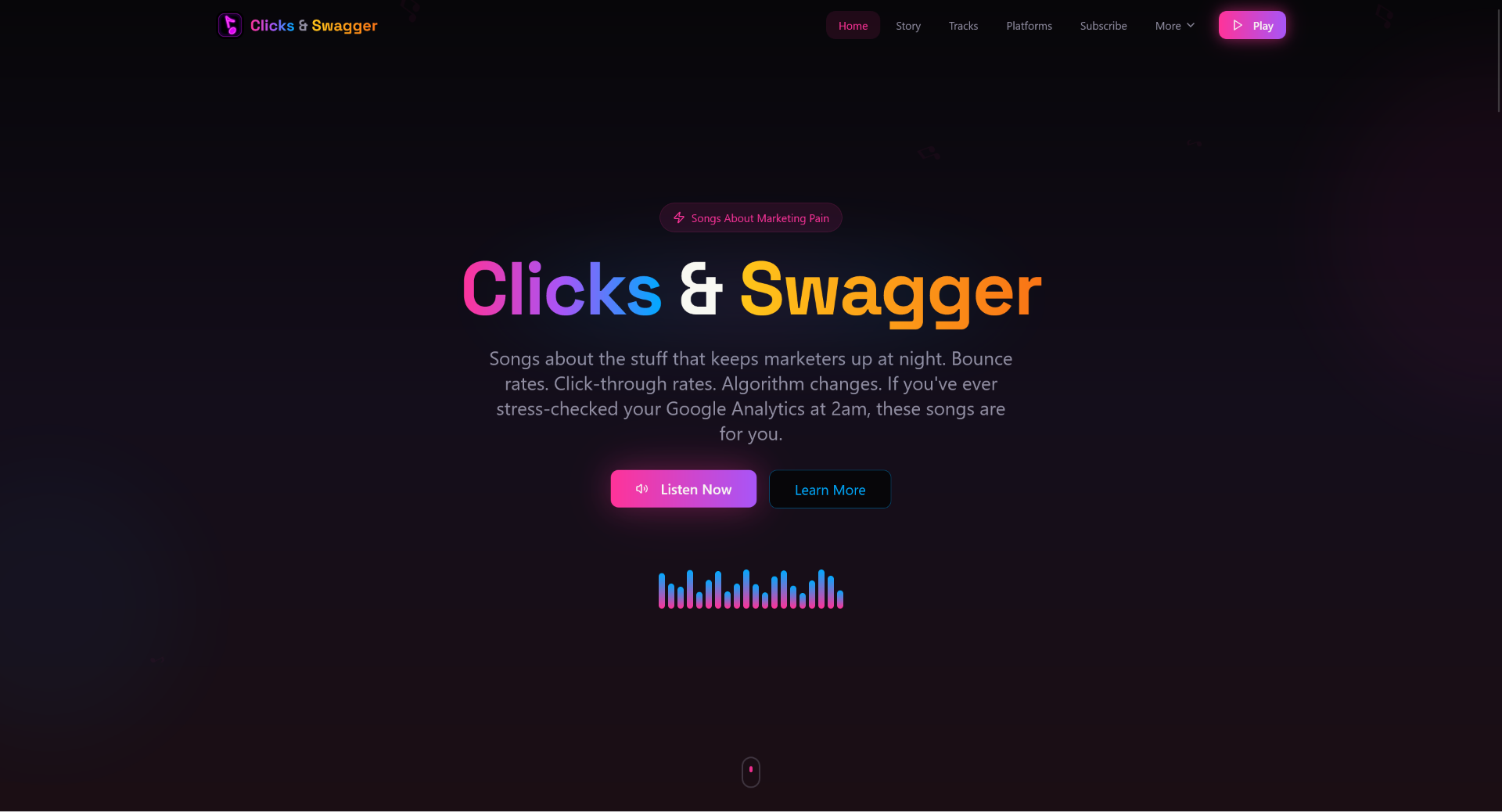
Let me be upfront with you: Clicks & Swagger is not a polished success story. It is not a case study about how I scaled from zero to a hundred thousand followers in ninety days while sipping coffee on a beach in Bali. There is no viral moment. There is no hockey stick graph. What there is, however, is something I find far more interesting and far more useful: a real-time demand generation experiment conducted in a space where traditional growth tactics simply do not work.
This is the story of why I decided to build an audience through AI-generated music in a niche where nobody is searching for what I am making, how I approached the creative process, what I have built so far, what is working, what is not, and where the whole thing is going. If you are here for vanity metrics and highlight reels, close the tab. If you are here because you are curious about demand generation in a post-SEO world, keep reading.
I am Lachezar Simeonov. I run 4 Pillars Digital, a founder-led growth marketing practice. Before that, I spent three years as a contract consultant in the Growth Marketing Manager role at iAffiliate. I have spent years in the trenches of organic growth, content strategy, and affiliate marketing. I have written more than a thousand articles across verticals. I have worked with tech and SaaS companies, e-commerce brands, and iGaming affiliates. I know how this industry works, and I know how most of us in it feel most of the time: exhausted, slightly misunderstood, occasionally furious at a client who just told us that their nephew can build the website for free.
That last feeling is exactly where Clicks & Swagger was born.
The conventional digital marketing playbook tells you to find your keyword, optimize your content, rank on Google, convert traffic into leads. It is a beautiful, clean framework that works brilliantly in categories where people actively search for solutions.
Except that in 2026, that playbook has a significant crack in it. AI overviews are swallowing search intent. Answer engines are giving people the answer before they ever click. Generative AI tools are replacing the top-of-funnel research phase entirely. The organic click is becoming a rarer and more precious thing. And for projects like this one, there is a more fundamental problem: nobody is searching for "funny marketing songs" or "Afrobeat tracks about SaaS burnout." There is no keyword to optimize for. There is no existing demand to capture. You cannot pull traffic from a river that does not exist. You have to make it rain first.
This is the core strategic insight behind Clicks & Swagger: it is a demand generation project, not a content marketing project. The distinction matters enormously. Demand generation means you are creating awareness and desire for something people did not know they needed yet. You are not competing for existing attention. You are manufacturing it. That is a harder game, a slower game, and in many ways a more honest game because you cannot fake your way through it with keyword stuffing.
So if SEO was off the table, what was the plan? Community. Authenticity. Music that made people feel seen. And a long, patient experiment in building something worth caring about.
The core idea of Clicks & Swagger is simple: make music about the real, lived experience of being a marketer in 2026. Not thought leadership. Not LinkedIn carousels about the five habits of highly effective growth hackers. Actual songs. Songs that capture the absurdity, the frustration, the dark humour, and occasionally the joy of working in this industry.
Why music specifically? A few reasons.
- Music bypasses the rational filter. When you read an article, you evaluate arguments. When you hear a song that articulates something you have felt for years, you feel it in your chest. That emotional resonance is extraordinarily difficult to manufacture and extraordinarily powerful when you get it right.
- The tools now exist. I use Suno AI, which lets me go from a concept to a finished track in hours. The quality is not Beyoncé. But it is good enough to make someone smile, share, or subscribe.
- Almost nobody in B2B marketing is doing this. That gap is the opportunity.
The goal was never for this to become a Spotify chart-topper. The goal was always to create a gathering point for marketers who recognize themselves in the music, who appreciate the absurdity being named, and who want to be part of a community built around that shared recognition. Music as a community magnet. That was the thesis.
Every Clicks & Swagger track starts with a pain point. Not a brand brief, not a keyword cluster, not a content calendar slot. A genuine, visceral, recognizable frustration from the marketer's daily life.
How a track gets made
- Identify the emotion. Frustration? Burnout? Dark humour? Solidarity? The emotion comes before everything else because the emotion is what makes the song resonate or fall flat.
- Find the specific scenario. Not "clients don't value our work" in the abstract, but "someone just told me my job can be done by their cousin." Not "automation is overhyped" in general, but "I automated everything, optimised every workflow, and I am still broke." Specificity separates a song people forward from a song people politely ignore.
- Experiment with genre. Different genres carry different emotional registers and shareability profiles. Afrobeat and Afropop have resonated well, probably because the inherently upbeat, danceable energy creates a comedic tension against the frustrating subject matter. You are dancing to a song about your client telling you their wife does your job on TikTok. That tension is funny. That tension works.
Two tracks have emerged as early favourites among the marketers I have shared them with.
My Cousin Can Do It
An Afrobeat-highlife track about the marketer in 2026 who is expected to be a copywriter, a data scientist, a UX designer, a psychologist, a project manager, and a growth hacker simultaneously - and who, despite this impossible scope, still gets told by a client that their cousin does social media and could probably handle it. The song captures the absurdity with enough specificity that anyone who has worked in marketing for more than six months will immediately recognise the feeling. It is not mean-spirited. It is cathartic.
Broke and Automated
An Afrobeat-funk hybrid that tackles the automation obsession currently gripping the business world. Everyone is automating. Everyone is implementing AI workflows. Everyone is cutting costs through technology. And yet an enormous number of solopreneurs, freelancers, and small businesses have automated their way into more complexity, more overhead, and less actual revenue than they started with. The song is funny. It is also honest in a way that most marketing content refuses to be.
Eighteen tracks in four months. Not all of them have hit the same way. The pattern I am learning is that genre experimentation and lyrical specificity are the two biggest levers. Vague relatable content gets a polite smile. Specific, named, honest content gets a share.
One of the less conventional decisions I made was to build the community infrastructure before I had a community. Most people wait until they have an audience before thinking about how to engage them. I went the other way.
The website at clicksandswagger.com has a feature that I consider the heart of the entire community strategy: a song idea submission and voting system. Visitors can submit ideas for the next marketing song and vote on all submitted ideas, including my own. The community, not me, decides what gets made next.
This is not a gimmick. It is a fundamental statement about what kind of community this is. It says: your voice matters here. You are not an audience, you are a co-creator. The music is not being made for you, it is being made with you.
The three-tier community model
- Tier 1 - Participation. The voting feature. Low commitment, high signal. Someone who submits or votes has told me they are engaged enough to take an action.
- Tier 2 - Subscription. The newsletter. Currently low, which is honest and expected. The goal is not to chase signups before the product has found its footing.
- Tier 3 - Conversation. Direct outreach. People who like the music enough to reach out about working together. This is the tier that connects Clicks & Swagger back to 4 Pillars Digital.
The community infrastructure exists and is live. What it is waiting for is traffic.
Clicks & Swagger is available on every major streaming platform - Spotify, Apple Music, Deezer, YouTube Music, YouTube, SoundCloud, and a long tail of smaller ones. People are listening. Not in enormous numbers yet, but across multiple platforms, which tells me the distribution infrastructure is working.
Social media is a different story. I have presence on TikTok, Instagram, Facebook, LinkedIn, and YouTube. I am not pushing any of them particularly hard right now. This is a deliberate choice, not a failure of execution. Clicks & Swagger is one of several projects I am running simultaneously - I also run 4 Pillars Digital, co-founded a pin e-commerce store with my wife.
What this means in practice is that social media is functioning as a broadcast channel rather than an engagement channel. I drop content when I have something worth dropping. I let the music find its audience organically. I am not running ads. I am not doing outreach campaigns.
Is this the fastest possible growth strategy? No. Is it the right strategy for this phase of the project? I think so. I am still learning which genres work, which topics land, which creative directions feel authentic versus forced. Pouring fuel on a fire before you know what you are burning is how you waste resources. Mastery first. Distribution after.
The numbers below are filtered. Bot traffic has been removed. I am not padding these figures.
- Unique human visitors: ~160 (bot traffic excluded)
- Unique song listeners: ~40 across all platforms
- Streaming platforms active: 10+ (Spotify, Apple, Deezer, YouTube, etc.)
- Tracks released: 18 (Jan-May 2026)
- Standout tracks: 2 (My Cousin Can Do It / Broke and Automated)
- Social platforms active: 5 (TikTok, IG, FB, LinkedIn, YouTube)
- Newsletter signups: Low, expected at this stage and not the current focus
Update, October 2026: about 250 site visits in the last 60 days, around 65 plays started on the website, and 2 click-throughs to SoundCloud and Spotify. A new song lands every week, plus community-voted songs on the 14th and 28th of each month, and the catalogue is on track for 50 songs by the end of 2026.
I wrote about the search strategy behind this, and what came of it, in I'm building an audience in a category that doesn't exist yet.
The number I find most meaningful is the forty unique listeners. Those are people who found the music, clicked play, and listened. In a project where no existing demand existed, forty people choosing to engage with something they had no prior reason to expect is a genuine signal. Small signal, but real.
The Spotify exit traffic from the website is also worth noting. A meaningful portion of visitors click through to Spotify, which tells me the website is doing its job as a conversion point.
Clicks & Swagger is not a hobby. It is infrastructure. Every decision is connected to a larger strategic architecture.
The personal brand site at lsimeonov.com is the connective tissue. Clicks & Swagger drives awareness. The website captures that attention and funnels it toward the newsletter, the community features, or direct conversations. 4 Pillars Digital sits at the end of that funnel as the primary business outcome. Someone who discovers me through a song about their professional frustrations already has a positive association with my brand. They already know I understand their world. That is an extraordinarily warm introduction. It is the opposite of cold outreach.
There is also a positioning layer. In a market full of consultants all claiming expertise in growth marketing, differentiation is everything. Clicks & Swagger is differentiation you cannot fake. You cannot manufacture the insider understanding that produces a song like "My Cousin Can Do It." You either know what it feels like, or you do not. If you do, you hear that song and you think: this person gets it. That is trust, built at scale, through music.
Beyond client acquisition, this project is a live demonstration of a capability I sell: demand generation in a space with no existing search volume. The case study you are reading right now is itself a demand generation asset. The meta-layer does not escape me.
Specificity wins every single time
The tracks that resonate are the ones where the scenario is painfully specific. "Marketing is hard" lands nowhere. "Your client's cousin does your job on TikTok" lands everywhere.
Genre is a strategic variable, not just an aesthetic choice
The energy of a genre carries emotional information before a single lyric is heard. A song about professional burnout delivered in a minor-key dirge feels like a complaint. The same content delivered over Afrobeat production feels like defiance.
Infrastructure before audience is not a mistake
Building the voting system before having significant traffic felt premature. In retrospect it was exactly right. When traffic comes, the engagement mechanisms are already in place.
Demand generation takes patience that content marketing does not
When you optimize existing demand, you can see results in weeks. When you generate new demand, you are planting seeds in soil where nothing currently grows. Patience is not just a virtue here. It is the strategy.
Honest positioning compounds over time
Every marketer who hears these songs and recognises themselves is a small deposit in a long-term trust account. I am not chasing viral spikes. I am building reputation, slowly and honestly.
By the end of 2026 I want to hit three measurable targets as the minimum viable threshold for considering this a confirmed strategy versus an interesting experiment that did not scale.
- Followers across streaming + social: 1,000+ - minimum viable audience signal
- Unique website visitors: 500+ - proves demand generation is working
- Community engagement: active voting and newsletter growth - validates the community architecture
Beyond the numbers, qualitative goals matter as much. Activate the social channels more intentionally as the catalogue grows. Make the voting feature genuinely contested. Have at least a handful of conversations that started with "I heard your song about the cousin thing" and ended with a business relationship.
None of this is guaranteed. That is the nature of experiments. But the framework is sound, the infrastructure is built, the early signals are real if small, and the direction is clear. Seven months is enough time to find out whether this thesis is correct.
Clicks & Swagger is, at its core, a project about a principle I believe strongly: people do not pay for information. They pay for access, experience, and implementation. They pay for people they trust. They pay for people who get it.
In a world where information is free and AI can generate any piece of content you want in seconds, the only real differentiator is authentic understanding combined with genuine relationship. Music is one of the oldest technologies humans have for creating that kind of relationship at scale. Before podcasts, before blogs, before newsletters, before SEO, humans have been using music to say: I see what you are going through. I feel it too. You are not alone in this.
That is what I am trying to build with Clicks & Swagger. Not a marketing funnel dressed up in a guitar solo. An actual community of people who share a professional experience, who laugh together at the absurdity of it, and who trust that the person who made the music understands the work well enough to actually help with it.
Eighteen tracks in. Just getting started.
Visit clicksandswagger.com to listen, vote on the next track, or just see what is happening.
Two of the tracks released under Clicks & Swagger. Both are part of the same community-driven music experiment.
Lead Gen Lullaby
Listen on Spotify, Apple Music, YouTube Music, or SoundCloud.
404 Love Not Found
Listen on Spotify, Apple Music, YouTube Music, or SoundCloud.
Do You Want to Work With Me?
I'm here to bring a hands-on approach, data-driven insights, and dedication to delivering measurable results - reach out anytime.