

Semrush just published one of the more interesting pieces of research I have seen this year: they analyzed 89,000 LinkedIn URLs cited by ChatGPT Search, Google AI Mode, and Perplexity, and mapped out exactly what kind of content gets surfaced.
If you work in organic growth, or you are trying to build a brand in a competitive B2B or iGaming niche, this study should be required reading. Not because it is surprising, but because it quantifies something a lot of us have been feeling for a while: LinkedIn has quietly become an AI discovery engine, not just a professional social network.
Here is what stood out to me, and what I think it actually means in practice.
LinkedIn is #2 in AI citations. That is wild.
Ahead of Wikipedia. Ahead of YouTube. Ahead of every major news publisher.
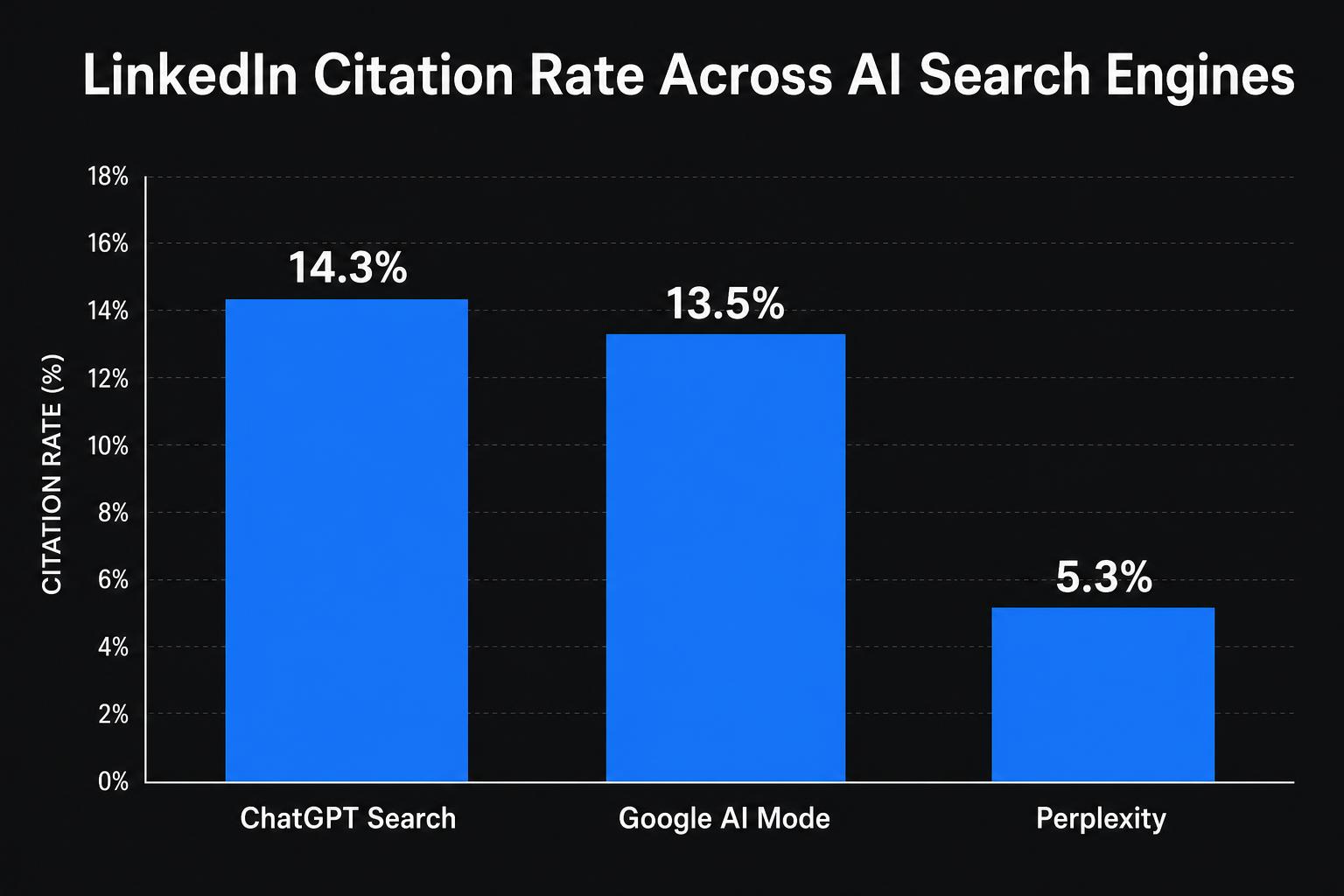
On average, 11% of AI responses reference LinkedIn content. On ChatGPT Search specifically, it is 14.3%. That is not a niche signal, that is a primary source of record.
For anyone doing B2B content strategy, this reframes the entire question of "why should we post on LinkedIn." It is no longer just about reach or engagement. It is about whether you show up when someone asks an AI tool a question in your category.
And if you are not publishing, someone else's content fills that space and defines how AI describes your space.
Your LinkedIn copy is becoming your AI brand voice
Here is the finding I think most people will scroll past without fully processing.
AI responses showed semantic similarity scores of 0.57 to 0.60 with the LinkedIn content they cited. For comparison: Reddit scored 0.53 to 0.54, and Quora a much lower 0.435.
What this means in plain terms: when AI tools cite LinkedIn, they do not just link to it, they borrow its language. The closer a score is to 1.0, the more the AI response mirrors the original phrasing. LinkedIn content is mirrored more faithfully than almost any other source in the study.
The implication is significant. Your LinkedIn copy is not just content for your followers. It is effectively becoming the vocabulary AI uses to describe your brand, your category, and your expertise to people who have never heard of you.
If your positioning on LinkedIn is vague, generic statements about "driving results" or "delivering value", that vagueness gets picked up and reflected back. If it is sharp and specific, that specificity sticks.
Which AI tool should you actually optimize for?
Not all three models behave the same way, and the differences are significant enough to affect your content strategy.
| Metric | ChatGPT Search | Google AI Mode | Perplexity |
|---|---|---|---|
| LinkedIn citation rate | 14.3% | 13.5% | 5.3% |
| Favors | Individual creators | Individual creators | Company Pages |
| Individual / Company split | 59% individual | 59% individual | 59% company |
What this means practically:
If you are trying to get cited in AI responses and you are a founder or subject matter expert, ChatGPT Search and Google AI Mode are your primary targets. Both heavily favor individual creator content. Invest in your personal LinkedIn presence first.
If you are a brand without a strong individual creator program, Perplexity is your low-hanging fruit. It disproportionately cites Company Pages, which means a well-maintained, regularly updated Company Page can start generating AI citations without you having to build personal brands from scratch.
I have actually seen this play out with clients. Individual creator content I have been managing has been showing up in AI-generated responses, and when I dug into which tool was surfacing it, it was almost always Google AI Mode. Which makes sense in retrospect: Google AI Mode heavily favors individual creators (59% of its LinkedIn citations), so if that is your primary AI search tool like it is mine, you are going to see that pattern reinforced. The data explains the experience, and the experience validates the data.
The "go viral" playbook is dead - good riddance
📉 The median cited LinkedIn post has 15 to 25 reactions and no more than 1 comment. Not 500 reactions. Not a post that "blew up." Just a reasonably helpful piece of content that clearly answered something.
I have been telling clients this for years: engagement vanity metrics are a trap. You do not need a post to go viral for it to do its job. You need it to be specific, credible, and findable. This study confirms that AI retrieval works the same way.
The parallel Semrush draws to Reddit is exactly right too: the threads AI tools cited most were not the upvoted ones. They were the quieter discussions with clear, direct answers. Relevance beats reach. Every time.
Originality matters more than you would think
95% of cited posts are original. Reshares barely register at 5%.
This is worth sitting with, because a huge chunk of what most brands post on LinkedIn is exactly that: reshared company news, reposted announcements, aggregated takes. It generates activity but apparently does not register as citable content.
The breakdown by content type adds more nuance:
- Articles (500 to 2,000 words) dominate citations at 50 to 66% depending on the platform
- Mid-length posts (50 to 299 words) perform best within the feed post format
- 54 to 64% of cited content is educational or advice-driven, knowledge sharing, practical how-tos, documented results

If you want AI visibility, you need to be creating something, not just amplifying.
Consistency beats clout
Around 75% of cited LinkedIn post authors published 5 or more posts in the previous four weeks. Occasional contributors barely show up.
But here is the part that should give smaller creators and leaner teams genuine confidence: individuals with under 500 followers were cited just as often, if not more, than those with 500 or more followers. The study does show that having 2,000 or more followers increases citation likelihood, but the gap is not as dramatic as you would expect.
AI does not care about your follower count. It cares about whether your content clearly answers something.
What I would actually do with this
A few concrete things this changes for how I think about content strategy for clients:
1. Treat LinkedIn as a search and discovery channel, not a social one. That shifts how you choose topics: less "what is trending" and more "what are people asking AI tools in our category."
2. Publish articles, not just posts. One well-structured article in the 500 to 2,000 word range does more AI visibility work than five clever posts. Build an article calendar around questions your audience is already typing into ChatGPT.
3. Post frequency beats follower count. Consistency and relevance trump reach. A subject matter expert posting 5x a week with real expertise will outperform a brand account posting once a week with polished nothing.
4. Define your terminology explicitly. If your positioning is vague or inconsistent, AI will paraphrase it into something generic. If it is sharp, it sticks. Treat your LinkedIn copy like messaging documentation, because for AI, it effectively is.
5. Do not pick between Company Page and personal brand, run both. Different AI tools favor different sources. Full coverage requires both operating in parallel, with consistent positioning across them.
The honest caveat
This is a snapshot from January to February 2026. AI retrieval is evolving fast, and the models themselves are in constant flux. What works today might shift in six months.
But the underlying logic, that clear, expert, original content from consistent authors will be rewarded, is durable. That is not just how AI works. It is how trust works.
The brands that build that habit now will be the ones showing up in answers when their customers are doing research. The others will be invisible.